Showing posts with label "6 traits posters". Show all posts

August 2, 2020

6-Traits Posters


We all need posters, online, or face to face it helps the kids learn the traits.



December 28, 2014

Color Coordinated Traits! by LaRae Kendrick

Color Connections with Revising & Editing

"At what point in the writing process do you work on correcting & editing?"

After a student has written their rough draft on a big assignment, I ask them to use the first five traits to revise (less than 5 traits for smaller assignments).

My characters, "Our Six Writing Friends," are color-coded and organized by the colors of the rainbow, ROYGBV. To begin the revising process, I ask students to use crayons, pens or digital highlighting and read through their work 5 times.


Examples:
Ideas-Red: Circle sentences that go off topic.

Organization-Orange: Draw an arrow that moves a sentence to a better place.

Voice-Yellow: Highlight a sentence that shows good voice or the author's personality.

Word Choice-Green: Draw a box around words that are used repeatedly.

Sentence Fluency-Blue: Read to a partner and have them mark a sentence that flowed well.

Once they have gone through the revision steps then they can start editing. Conventions-Purple.

Conventions is always checked in 4 separate steps.


  1. Capitalization
  2. Punctuation
  3. Spelling
  4. Grammar


Now they are ready to take the colorful draft and create a clean and polished final draft. "Polished, not Perfect!"

This step-by-step revising is best for assignments that the students have spent a fair amount of time on, usually the types of writing required by the grade-level standards.

For example, my 3rd grade class was required write research reports. When they had already spent up to two weeks researching and writing their first drafts, it made sense to spend extra time revising and editing.


When they were done with their rough draft, they would start with the first color, ideas/red, and read through their paper looking for details that didn't fit. When they were done, they would move on to the next trait/color. Sometimes a student might take one writing period just to check their ideas and organization.

At the beginning of our writing time together, we would review each color and what the students should be looking for. They knew that their peers may be ahead or behind them. Some may even still be writing! No one seemed to mind reading their stories more than once, because they knew they were looking for something new each time.


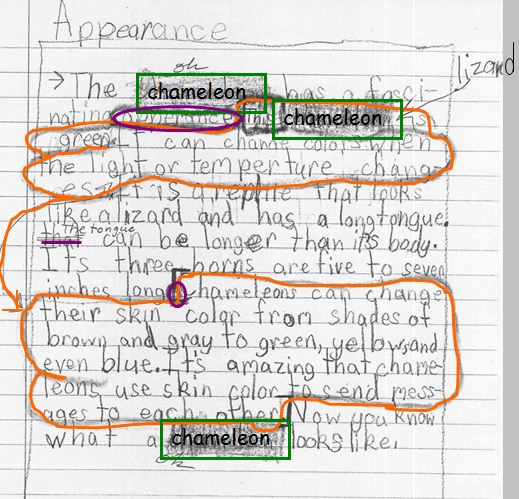
Sample:

The sample displayed is the appearance paragraph of a rough draft from a report about chameleons. Notice how the student sees that he repeated chameleon, green/word choice, so he changes the second occurrence to "lizard." (This is all resulting from a mini-lesson that was taught before one of the writing periods.)

He also used orange/organization to draw an arrow moving the first sentence about the lizard's skin next to the other sentences about its skin. Again, this is not something that he naturally knew, but that he learned from a mini-lesson.

Because "Our Six Writing Friends" visual aids are color-coded on the bottom, students are quickly able to refer to which color to use.

Whichever visuals you use, I suggest color-coding them for quick reference. It could be as simple as attaching pieces of construction paper to the back.
-----------------
LaRae Kendrick, M. Ed., is a native of San Jose, CA who now lives in Gilbert, AZ. She is an experienced writer and educator specializing in language arts education. She was the director of curriculum development for A Plus Educators and has presented teacher workshops on a variety of topics nationwide. LaRae has served as a leader for numerous state and district writing committees and as a former classroom teacher, she understands the need to master state standards while being realistic about life in the classroom. As the author and creator of Our Six Writing Friends™, she is dedicated to the goal of helping all students become better writers. Her areas of expertise are Six Traits Writing, writing assessment, utilizing interactive whiteboards and the writing/technology connection.


LaRae is a teacher’s teacher who energizes and inspires her fellow educators. A participant in one of her professional development sessions recently stated, "Your workshop was so motivating for me… I couldn't even sleep last night because I could not wait to get back in the classroom and start teaching writing. You have inspired me."

Visit LaRae at HelpKidsWrite.com to find out more!

December 10, 2014

Synesthesia, Painting, Poetry, Sentence Fluency, Rhythm with Toby Lurie

Poetry - Painting - Song 

Later in my teaching practice I started writing grants to bring writers and illustrators to my school district. This helped me build a relationship with painter, musician and poet, Toby Lurie: http://www.tobypoet.com.

Toby is an amazing, creative, and unpredictable guy. (The link to his site will introduce you to his work. He shares many QuickTime audio clips of his work that trigger creativity.) It is fun to find him on the Internet after all these years.

I recall meeting him for the first time. Toby was wild white bearded poet with a dangerous gleam in his eye. One look at him and I realized that he was going to draw some lightening.  I was the language arts coordinator for a conservative Nevada school district. I knew Toby was going to make waves and I was glad to aide and abet in a little artistic subversion.  We were at the district's biggest high school.  I'd planned a full school assembly, but an uptight vice principal sand bagged me and side tracked us to a remote spot in the school where they kept the 'tough' kids.

As I was about to introduce Toby to a huge high school class of alternative ed kids.  I didn't have a clue what he was going to do. The rowdy with the bored vibe of caged cats.  I was sure this crowd of edgy and angry high schoolers would tear him apart. 

Just as I introduced Toby, he whispered in my ear, "Tell them I don't speak any English."  I followed his lead and got out of the way.

Toby proceed to emote with sounds and facial gestures and within seconds he captured everyone's attention. He spoke gibberish but it didn't matter. This guy knew how to communicate with sound alone, words were an afterthought. The kids were riveted by the odd man capering and grunting in front of them.

By the end of the assembly everyone was up moving and chanting,  found poetry echoed off the walls and we were all swimming in Toby's unique tone patterns.  Sometimes it's good to be in alternative ed!

To really appreciate Toby's work you need to hear and see him. This new video Synesthesia Part 1 will give you a taste. 


Synesthesia part 1 from Terrence Vaughn on Vimeo.

Choral Reading, Toby Style

Several years later on one of his return visits, Toby taught me a great method that ties perfectly into the concepts of rhythm and sentence fluency. After a writing session, Toby had each student pick a single line from their work. Then he called 6-8 volunteers to come to the front of the room. They lined up shoulder to shoulder and started to read their lines in order from left to right. The first boy read. Then the second. Suddenly Toby would point back to the first and have him repeat the line. Toby would  would mug and gesture and flail his arms all to draw more emotion and voice from the reader.

We soon understood that Toby was conducting a word orchestra.

They began reading their lines louder or lower, deadpan or angry, happy or weeping. Once the whole line had read once, Toby layered together a sound poem based on the melodies of repeated lines and varied voice.

Sometimes Toby had the same student read two or three times in a row or come back to one particularly powerful line repeatedly. No one in the chorus knew when they'd be called on and everyone was amazed at the nuances and lunacies that spilled out of it all.

Toby created a wild reader's theater display of word choice, sentence fluency, voice, organization, and ideas all wrapped in a spontaneously generated poem. It was hilarious, energizing and fun. Everyone loved it.

All of this points to the powerful mix of music, performance, and poetry that supports sentence fluency (and all the other traits as well).

I  used this method myself two or three times a year for the rest of my classroom teaching career. I got so I could conduct a pretty good sound/word poem, but I could never top the Maestro!


Synesthesia part 2 from Terrence Vaughn on Vimeo.


September 18, 2011

Helping teachers become writing teachers.


Syllabus


How this class came to be:


My first formal online learning experience was in 1996. I took an online class offered by the Milken Family Foundation that was mentored by the great Lajeane Thomas of ISTE and Louisiana Tech renown. Thanks to LaJeane I returned to school and earned an online masters degree focused on online teaching and learning.

I began teaching online in 1999. I wrote and started teaching my 6-Traits class in 2001 for the University of Northern Iowa. I moved the class to the University of Wisconsin Stout in 2005. I've taught the course nearly every semester for the past 10 years.

The two essential drivers that make this class work are a very strong sense of community that encourages teachers to share methods and practice scoring of papers using a number of databases that provide expert feedback. It's all about hands on discovery of highly practical ideas. My litmus test is: "Will this work on Monday morning?" I also enjoy helping teachers discover that they've been teaching with the traits all along. Learning the vocabulary of the traits helps everyone understand the bigger picture of writing instruction.

I learned about 6-Traits and the writing process when I was an elementary teacher in the 80's. Later, as a district Language Arts coordinator, I worked with the Northern Nevada Writing Project to train dozens of teachers. This early exposure to the writing process, combined with 25 years in the classroom and 10 years online make this online class a rich experience.

I love teaching this class. It's a chance to connect with teachers from around the world and share practical methods and materials about 6-Traits and the writing process.

I also publish the 6-Traits Resources Facebook Page as a way to share ideas about writing and teaching. https://www.facebook.com/6Traits


If you now of anyone who would be interested in this class pass it on? 


Helping teachers become writing teachers is one of the most satisfying things in the world. ~ Dennis

University of Wisconsin-Stout of EDUC 744 Teaching and Assessing Writing with the 6-Traits. 
For more information: http://www.uwstout.edu/soe/profdev/traits.cfm

September 12, 2011

Fall 2011: Online Class: Teaching and Assessing Writing with the 6-Traits


EDUC 744 3 graduate credits 


EDUC 744 920 Elem (PK-4) 3 graduate credits September 26 – November 18, 2011
 

EDUC 744 909 Middle School-Adult 3 graduate credits September 26 – November 18, 2011

Learn to teach and assess writing with the 6-Traits of writing
(voice, ideas, word choice, organization, sentence fluency and conventions). Learn to use the 6-Traits with the writing process to teach revision strategies. Help learners meet higher standards and improve test scores.

What students are saying:

 "I began this course thinking of myself as something of a blank slate with regards to the teaching of writing. I felt that writing was often a hit or miss proposition in my classroom. Today I see that while there are certainly holes in my second grade writing instruction, I'm actually doing more then I thought. I'm not starting from square #1. Today I'm able to categorize and organize what I'm already doing, plus add new things, using the framework of the 6 traits."

"I feel very fortunate to be taking a course like this so early in my teaching career. Someone mentioned to me recently that while there are many great ideas within the 6 trait model, it's easy to slip back into one's old ways of doing things. Perhaps I'm lucky in that I have no old ways to slip back into."

"I've had several important realizations as a result of work we've done these past weeks. The first is the specific connections that I now make between reading and writing. Naturally I was always aware that a connection existed. I knew on some level that reading to my kids was beneficial to their writing development. But too often the reading was undirected and without a plan. Today I have an arsenal of literature with which I can model, discuss, and teach specific traits in a focused way. And I don't have to teach writing alone. I now have the great authors of the world to help me. I can point to a piece of literature and say to my kids, "Take a look at what this author has done. We can do something similar in our own writing."

I've been teaching this course online for almost ten years.  It remains my favorite course because I get to help teachers from around the world transform their thinking about teaching writing.  Join us!  It's a remarkable experience in community, sharing, and new learning! ~ Dennis O'Connor

Collaborative Writing Platform: Thumbscribes


Posted from Diigo. The rest of 6-Traits Resources group favorite links are here.

Twitter: One way to find your writing process

Posted from Diigo. The rest of my favorite links are here.

Primary Sentence Fluency Whales Passing

Posted from Diigo. The rest of my favorite links are here.

August 30, 2011

6-Traits Posters

Back to School Traits Posters


Posted from Diigo. The rest of 6-Traits Resources group favorite links are here. (Feel free to join us on Diigo!

August 22, 2011

NWP - Connect Join the National Writing Projects Social Network

The National Writing Project has launched a social network that all writing and reading teachers should consider.  At a time when writing and writing instruction is generally neglected it is important for all of us to find others who understand and share the vision of what a truly literate person can be.

NWP Connect: Don't go it alone!  Join NWP Connect! 


This is a new project for the NWP.  You have a chance to be an 'early adopter' as you connect with other writing teachers from around the world.

I discovered this site today. I'm in the process of setting up my profile.  10 years of teaching online lets me know instantly how important the new NWP Community can be. I believe in the reality of online community and the support of virtual writing teachers. All it takes is a willingness to share and think.

See you online!

Dennis

August 21, 2011

6-Traits Bulletin Boards


    • Teachers have been introducing the trait language to students in a variety of ways. Here are some of my favorite 6-Traits introduction strategies. Thanks to all of you who have sent in new pictures! If you would like to email digital photos of how you have introduced the traits into your environment, we’ll post them on our website for all to see. Click on some of the photos below for a larger view of the bulletin board.
Posted from Diigo. The rest of my favorite links are here.

July 26, 2011

Five Card Flickr

  • "This quasi experimental web site is designed to foster visual thinking. It is based completely, or more loosely... copied, from the Five Card Nancy game devised by comics guru Scott McCloud and the nifty web version at 741.5 Comics.

    However, rather than drawing from a hand of randomly chosen panels of the old Nancy comic, my version draws upon collections of photos specified by a tag in flickr. You are dealt five random photos for each draw, and your task is to select one each time to add to a selection of images, that taken together as a final set of 5 images- tell a story in pictures.

    When you are done, you the option to add a title and explanation, then you can save the story so you can put a link in your resume or send to your Mom (she pay print it out and tape it to the fridge, or she may criticize your creativity, your mileage and mom may vary). Plus we offer the ability to tweet your story or use an embed code to add it to your own web site."
    tags: 


    Five Card Story: A Nice Fall Day

    a Five Card Flickr story created by magster400


    flickr photo by katerha

    flickr photo by krutscjo

    flickr photo by krutscjo

    flickr photo by katerha

    flickr photo by krutscjo


    One day, a couple was went on vacation. Their plane flew them to an area in Canada where it was pretty chilly. They saw a leaf that they thought was very beautiful. They continued walking around and touring the area. Everyone they talked to was very kind to them, but they were always saying things about an amazing castle that was rumored to have been home to a great king 569 years ago. No one had seen it since a ferocious animal had forced them to leave the area. Now, the couple had been sent to find it. They set off and traveled for many days. Just as they were about to give up hope, they found a garden with sculptures and fountains. Positive that this was the castle they drove back to their original destination through lots of snow to tell the waiting natives of their success. By the time they got back there were many more leaves on the ground. They told the people all about their adventure and were so tired that they immediatly hopped on a plane and headed home. This had been a vacation they could never forget!

    Synonym Toast : Word Choice Game


    Pic Lits : Playing with word choice

    Inspired picture writing
    Drag and drop words on to pictures
    possible poetry, idea generation, word choice applications

    July 21, 2011

    Color Poems Word Choice & Fun!


    Hailstones and Halibut Bones & Color Poems by Karen Grunder


    That old Hailstones and Halibut Bones book motivated me to develop
    a lesson for color poems!

    We brainstormed ideas for one color (red) as a class, sense by sense.

    The students would do it individually first on their own paper,
    then we would share and record all ideas on chart paper.

    The next day we picked the ideas for each sense we thought
    were the strongest, and worked on putting a poem together
    and making each image even more powerful. We balanced
    the amount of sense images (didn't want to overload on the visual).
    Hearing and feeling (emotion) were frequently the challenging
    ones for 10 year olds, but sometimes ended up being very
    effective parts of their poems when they later wrote their own.
    "Showing, not telling" was a big part of this lesson. Finally,
    the children got the chance to choose their own color, and
    brainstormed their own ideas. Lots of excitement!

    Yellow is....
    the smile in my mom's eyes whenever she looks at me
    the first notes of the ice cream song - "Run! Find the truck!"
    huge fields of daffodils rippling like waves as each gust hits…

    These poems were little treasures. The majority of children
    in the class got their poems published in a poetry book through
    a contest I entered. (Not a thing I regularly do, but someone
    handed me the poetry contest sheet just as we were doing the activity).

    This is an easy and effective way to get children to play with words
    to paint pictures and evoke emotions. A lot of talk went into the
    most effective way of sequencing ideas. Mood, balance, dynamics,
    and the importance of leaving the reader with a strong, final
    image/thought also came up. Such fun! So much covered in one
    much enjoyed writing activity!

    This year I'd like to get them to take digital pictures or use the web,
    and create a collage of any images or emotions from their poems
    that could be caught with a camera. I would tell them this after
    they finished their poems, though. I wouldn't want their inspirations
    to be restricted by practicality.

    Karen Grunder
    (Summer 2008: Teaching and Assessing Writing with the 6-Traits)

    Lesson Extension from Read Write Think:
    Color Poems—Using the Five Senses to Guide Prewriting

    June 11, 2011

    Facebook and 6-Traits Time to make the connection!

    Find great writing contacts on Facebook!


    I've just setup a page on Facebook. You'll find the 6-Traits Resources page here.  


    Please drop by and click LIKE?  ~ Den


    Corbett Harrison's Facebook Page 


    The National Writing Project Digital Writing Page


    National Writing Project  Digital IS

    Be sure to check out the Digital IS webpage as well!


    Vicki Spandel and Jeff Hicks on Facebook 6-Trait Gurus  


    Don't miss their new SixTraitsGurus Blog


    National Writing Project - Help Keep It Alive!

    NWP's web resources are spectacular.  Join for NWP Interactive  Free!


    June 3, 2011

    Word Mandalas & Pizza Memories


    Teaching and Assessing Writing with the 6-Traits (Online Graduate Class)

    Posted from Diigo. The rest of my favorite links are here.

    Barry Lane's YouTube Channel!

    Barry Lane!
    YouTube - Explode a Moment with Barry Lane

    This is a terrific mini lesson from Barry Lane. He shows (not tells) how to explode a moment into a full page of rich writing. The visuals in this video will catch any student's attention. I've called this technique the Magnified Moment. It's also tied to the idea of using imaginary binoculars to really see the details of an event. Fun to watch, this video is part of "Barry in a Box", a book and dvd Barry is selling on his website: www.discoverwriting.com

    A Horn for Louis, how Louis Armstrong found his passion. Great anecdotes about Armstrong, Marc Chagall, and Harry Houdini that lead to Kimmel's books. Children's author Eric Kimmel describes how to find your passion. More information about Eric's work at www.erickimmel.com.

    Posted from Diigo. The rest of my favorite links are here.

    May 28, 2011

    Help Kids Write! Animated posters


    Help Kids Write is a wonderful resource!

    This site is from LaRae Kendrick, a veteran teacher and nationally know presenter on 6-Tratis.  She's created some very clever posters to help kids remember the traits.

    Each page features a character who embodies the trait. Included are essential ideas about each trait. This would make a great smart-board intro to each trait!

    Here's a link to Ida Ideas! You can click through all of the traits from this page.

    tags: "6-traits training 6-traits"

    Writing Across the Curriculum (WAC)!