November 26, 2014


August 3, 2014
Writing Process / 6-Traits / Web 2.0
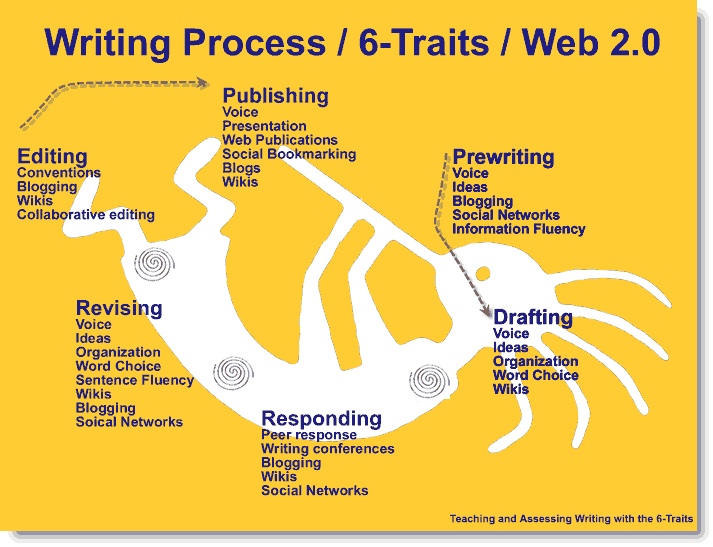
Right click link to open in a new window. Then right click image for download options.
Do you agree with this view? Suggestions? Additions? Questions?
I'm listening! ~ Dennis
Teaching and Assessing Writing with the 6-Traits (Online Graduate Class).
August 1, 2013


March 3, 2013
Outlining: Before or After? - Choice is the answer~
"One method I use to teach organization is outlining the paper after the first draft. I ask students to write an outline of their paper if it is poorly organized and if they don’t see the lack of organization. "
~ Kathleen Sommers - Teaching and Assessing Writing with the Six Traits, Spring 2013
I responded to Kathleen's post:
Your method of outlining after the first draft makes a great deal of sense. My Eureka Moment is that I (as a student) never experienced this approach. Instead I was always required to write the outline before my first draft. This never worked for me and permanently put me off outlining. Consequently I never really required/or taught outlining as a teacher. I was a bubbling brainstorming kind of writer and that's what I taught (although I told my kids that if they preferred to outline or list go right ahead.)
Your simple and common sense approach honors the writing process and amplifies the traits approach.
I'm amazed that after all these years this method didn't occur to me. I think had too much scar tissue because of the early demands for outlines before I'd properly generated my ideas and drafted a first splash at the topic.
Anyone else have a similar experience?
This post triggered a cascade of agreement from other writing teachers who struggled with outlining. The simple fix of using an outline after the first draft suddenly seemed self-evident.
Kathleen added a great concluding insight to the conversation:
"I do think it depends on the writer. There are many writers that need to start with the outline first. These writers would be very frustrated if told to write and then outline. It appears the more I learn about writing, the more I am aware there are as many ways to approach writing as there are writers."
I came back with an extension of the idea that wrapped up a very solid discussion.
Kathleen, You make a good point about the need for choice. Offer your students the opportunity to outline before or after the first draft. Let each writer develop their own process. The writing process shouldn't be a lock step formula, it's more of a path to help us find our words.
This same approach could be used with any graphic organizer: give the writer a choice, before or after. Building in this bit of organization during the drafting stage is what we are all after. These ideas make the abstract concrete!
Dennis
December 3, 2011
Digital Writing Workshop: The Writing Process Evolves
The digital writing workshop ning Troy mentions at the end of this broadcast is no longer online. For a vibrant online community investigate Jim Burk's English Companion Ning.
Also this blog post from the Enhanced English Teacher will give you more information and ideas about Troy's Digital Writing Workshop
October 22, 2011
July 21, 2011
Color Poems Word Choice & Fun!
| Hailstones and Halibut Bones & Color Poems by Karen Grunder | ||
 | ||
That old Hailstones and Halibut Bones book motivated me to develop a lesson for color poems! We brainstormed ideas for one color (red) as a class, sense by sense. The students would do it individually first on their own paper, then we would share and record all ideas on chart paper. The next day we picked the ideas for each sense we thought were the strongest, and worked on putting a poem together and making each image even more powerful. We balanced the amount of sense images (didn't want to overload on the visual). Hearing and feeling (emotion) were frequently the challenging ones for 10 year olds, but sometimes ended up being very effective parts of their poems when they later wrote their own. "Showing, not telling" was a big part of this lesson. Finally, the children got the chance to choose their own color, and brainstormed their own ideas. Lots of excitement! Yellow is.... the smile in my mom's eyes whenever she looks at me the first notes of the ice cream song - "Run! Find the truck!" huge fields of daffodils rippling like waves as each gust hits… These poems were little treasures. The majority of children in the class got their poems published in a poetry book through a contest I entered. (Not a thing I regularly do, but someone handed me the poetry contest sheet just as we were doing the activity). This is an easy and effective way to get children to play with words to paint pictures and evoke emotions. A lot of talk went into the most effective way of sequencing ideas. Mood, balance, dynamics, and the importance of leaving the reader with a strong, final image/thought also came up. Such fun! So much covered in one much enjoyed writing activity! This year I'd like to get them to take digital pictures or use the web, and create a collage of any images or emotions from their poems that could be caught with a camera. I would tell them this after they finished their poems, though. I wouldn't want their inspirations to be restricted by practicality. Karen Grunder (Summer 2008: Teaching and Assessing Writing with the 6-Traits) Lesson Extension from Read Write Think:
| ||
February 15, 2011
eMints: Great 6-Trait Resources

With this in mind, I was delighted to find the following 6-traits materials on the eMINTS site.
Writing: 6 + 1 Writing Traits eThemes eMINTS Home page for eMINTS 6-Traits materials
Grammar: Interactive Writing Activities eThemes eMINTS
These sites feature interactive grammar and writing sites that are fun to use with SMARTboards. The online games and quizzes cover topics such as nouns, verbs, sentences, proofreading, capitalization, punctuation, plurals, and more. (del.ious.us tags: writing 6-traits)
October 18, 2010
Effective Feedback: One trait at a time
Feedback that is highly focused on a single trait is most effective.
Think of the 'praise sandwich' approach: specific traits based praise for a writing strength is the bread. A focus on ONE area for improvement with a writer's trick is the meat and garnish.
Also don't feel you have to assess for all the traits every time. Scoring many papers is the best way to learn the traits. Scoring one trait at a time is a way to lock in the concept.
Quick feedback on the accuracy is essential as well. That's why the NWREL database of sample papers is such a treasure: http://apps.educationnorthwest.org/traits/scoring_practice.php
In the real world where you have hundreds of papers to consider, assessing all of the traits isn't effective.
When I was teaching I had between 160 -180 7/8th graders. At first I tried to do three full 6-traits assessments a year. Then it was two, at the end, just one.
Why? Because I'd burn out on the assessment and the kids got very little from my efforts. Once something is 'assessed' at that level, it's done and young writers usually won't pay much attention to advice on a finished project.
I decided to put my time into direct coaching and started doing much smaller paragraph level assessments when I absolutely had to have a 'record' for the grade book. I used a modified portfolio system, but it wasn't a commonly accepted method in the very small rural district where I worked for most of my classroom career.

The larger global assessment was usually reserved for the 'publication' pieces. I think back on the huge work of preparing publications and look up on the book shelf at a dozen books created by my classes and just shake my head. It's fine to have something tangible.
Now I wish all of the work was online. The KMSoul project was done about 10 years ago, the last year I was in the classroom. That was back before it was so easy to publish online ( a far more effective way to motivate kids than a bound and printed book because on the net they have a much larger peer audience).
I hope this little personal narrative helps!
Dennis
October 3, 2009
Modeling Writing with 6-Traits + Podcast Sharing
 I've done 3 traits so far this term and have never received such overall great writing from a class. The three or four that really shine have become 17 and 18. I am truly impressed with the improvement and excitement about their writing (and honestly - I'd put a lot of energy into my writing program BEFORE 6 Traits!).
 I really think the key changes for me in my teaching were including a lot of modeling of my own work with the students. When they see the time and effort I've put into my samples for sharing (of both good and bad writing!) they know I'm looking at specific features of their own writing very thoroughly. The very methodical coverage of key points for each trait helps students see, in a tangible way, what they need to address when they are writing.
Inspiration diagrams of each trait (simplified) help the children check their work for each of the significant points of the trait. I'm having them color in their own diagram, and I color one as I'm marking. We have a mini conference to compare and discuss our evaluations.
I came up with a rather neat plan. Using GarageBand ( a Mac program that allows one to create a podcast very easily), I had the children each rehearse and make an aural podcast of themselves reading their stories. They put them into our classroom public folder where anyone in the class can listen to them. Not only are they working on their reading fluency and expression, they have a whole class audience. I get to listen to everyone's aural reading at my leisure, and can choose samples of exceptional work to use as examples for the rest of the class.
My next challenge is to figure out how I can get the students to email their file home. How wonderful for a parent to be able to listen to their child reading their own story!
Gotta love this technology!
Karen (Grade 5 teacher, 31 years experience)
May 28, 2009
Tired of Being a Red Ink Slave to Corrections?

I'm delighted to announce my latest article is now on The Writing Teacher: Tired of Being a Red Ink Slave to Corrections? This article is based on a lecture from my course, Teaching and Assessing Writing with the 6-Traits.
As part of this publication, The Writing Teacher is sponsoring a Free Webinar on June 2, 2009 11:00 am PDT. I'll be online live talking about how editing fits in the writing process; thanks to Wimba and Learning Express e-folio.
Here's the teaser:
Are you burning yourself out offering comments that are ignored? Are you a red-ink slave spoon-feeding your students doses of correctness? The Editing Not Correcting Webinar will help you shift the burden of correcting conventions to where it belongs: on the student. Shift your thinking and help them learn to become editors and assessors of their own writing.
I hope to see and hear you online!
~ Dennis
May 27, 2009
Effective Communications Month

Resources from Annenburg Media & Learning.org
In "Teaching Persuasive Writing," http://www.learner.org/
An understanding of one's audience is absolutely essential to successful communication. In the program "Different Audiences," http://www.learner.org/
Fifth-grade teacher Laura Alvarez guides her students through techniques of debate and persuasion, plus research and organizational strategies, in "Social Justice and Action," http://www.learner.org/
Effective rhetorical strategy depends on a sound understanding of psychology. Learn more about how the human mind works with Discovering Psychology: Updated Edition. http://www.learner.org/
See how communication fosters an understanding of mathematical ideas and the language of mathematics in the "Communication" programs of Teaching Math: A Video Library, K-4 http://www.learner.org/
The programs of News Writing http://www.learner.org/
Learn ways to help your students communicate more effectively in a foreign language. Watch "Delivering the Message," http://www.learner.org/
Teachers encourage high school students to communicate genuinely and creatively through dance and visual media in "Fostering Genuine Communication," http://www.learner.org/
May 18, 2009
The Write Guy: Jeff Anderson
 Jeff Anderson offers powerful resources for all of us looking for an effective, positive, and thoughtful way to improve student writing conventions with a writing process approach.
I always suggest that teachers leave their red pens behind and shift responsibility to the student by teaching them editing skills. After all, when we do all the correcting, we also get all the practice.
For more on this approach see my latest article on The Writing Teacher: Tired of Being a Red Ink Slave to Corrections? This article is based on a lecture from my course, Teaching and Assessing Writing with the 6-Traits.
However, the road to great conventions is paved with more than editing lessons... as Jeff Anderson will help us see.
Notable Sentences Blog
Loren Wolter maintains this remarkable resource. "This blog is a resource for teachers who wish to view grammar as something to be explored and not just corrected. Sometimes even teachers who want to set aside tired, old daily language practices have trouble doing so due to the seeming abundance of those deplorable, error-filled sentences and the apparent lack of stimulating, "explore-able" model sentences. As you read adult, young adult, and children's books, please share the noteworthy sentences you find, so that we may build a useful resource together."
Jeff Anderson Resources:
The Write Guy
This is Jeff's personal website and it has resources you need. Well worth exploring. From his site: "Jeff Anderson has taught writing and reading for over 18 years. Over his career, Jeff has worked with writers in grades K-12, focusing in grades 4-8. Jeff’s passion is motivating and developing struggling writers with instructional strategies such as writer’s workshop and process writing, with a particular interest in making editing and grammar in context a meaning-making experience for students and teachers. Sharing strategies to create positive attitudes and confidence in young writers are central goals of his staff development and writing. "
Stenhouse Publishing: Author's Page
Jeff's books are published by Stenhouse. They have a lot of Jeff's work available online. (For Free!)
Everyday Editing: Inviting Students to Develop Skill and Craft in Writer's Workshop
Mechanically Inclined: Building Grammar, Usage, and Style into Writer's Workshop
Zooming In and Out: Putting Grammar In Context Into Context (PDF)
Copyright 2006 by the National Council of Teachers of English. Reprinted with permission.
"Jeff Anderson’s lessons involve shifting focus between writing or reading and specific grammar problems inner-city middle school students encounter. Lessons or discussions on a topic are then applied to a larger context so that students see “the story of grammar’s power to communicate meaning and beauty.”
Author's in Action: Jeff Anderson demonstrates an alternative to daily oral language.
A podcast of Jeff working with teachers using an editing activity based on a mentor sentence of writer Maya Angelou
The Craft of Grammar (DVD): Integrated Instruction in Writer's Workshop
(DVD, some online video clips!)
- Grammar Instruction Integrated Into Writer's Workshop: (Quicktime Video)
- The Hair Lesson: (Quicktime Video)
--------------------------
If you've been looking for a new way to improve writing conventions, you've found it! ~ Dennis
January 29, 2009
How to Introduce the 6-Traits

"Writing taught once or twice a week is just frequently enough to remind children that they can't write and teachers that they can't teach. They are both like athletes who never get in condition, yet have to play the game before derisive spectators."
-- Donald Graves, Writing: Teachers and Children at Work
I'm happy to report that the The Writing Teacher has just published my article on How to Introduce the 6-Traits. I'll be using this article in my online 6-traits writing class.
Click on over and give it a read!
You'll also discover rich resources for all who love teaching writing.
From The Writing Teacher:
- How to Introduce the 6 Traits
- Teaching Writing by Creating a Website
- Teaching Beowulf to Vikings Fans by Liz O'Neill
- The Art of Teaching Writing by Alan Gibbons
- A Few Principles of Writing Instruction by Michael Hebert
- The Tips and Techniques Contest @ The Writing Teacher
- Teacher Shannon Snowball Discusses the Impact of Automated Essay Grading on her Students' Writing
- Writing Lessons that Made the Biggest Impact on Teachers
- Teaching Writing in the Diverse Classroom: An Interview with Barbara Friedlander
- Research-Based Best Practices for Teaching Writing: A Discussion with Steve Graham on How to Effectively Teach Writing
- Virtually all US Students Proficient in Writing
I hope this helps!
~ Dennis
Teaching and Assessing Writing with the 6-Traits: Still time to join!

Final Call for the Spring Semester at the University of Wisconsin Stout!
Courses are completely online.
EDUC 744 920 Teaching and Assessing Writing with the 6-Traits - (Elem. (PK-4)
3 graduate credits begins February 16, 2009
http://www.uwstout.edu/soe/
EDUC 744 909 Teaching and Assessing Writing with the 6-Traits - (Middle School/Adult)
3 graduate credits begins February 16, 2009
http://www.uwstout.edu/soe/
Online Writing Resources: Very Cool Tools
10 Digital Writing Opportunities You Probably Know and 10 You Probably Don’t | ICT in my Classroom
I've seen the connection between information fluency and writing since my early work researching in the field. Here's a strong blog post chock full of interesting tool recommendations. Just a few are detailed in this post. Click through to ICT in my Classroom for a real treasure trove of online writing resources.
- On Thursday I finally had some time to sit with our Key Stage 2 (junior) literacy coordinator and talk about how technology can support writing outcomes for the Primary Framework for Literacy.
- 10 - Myths and Legends Story Creator 2 - a free online version of Kar2ouche that focuses on a specific story type. Classes can have unique logins and they can record audio and build scenes from a set of graphics, their own images can be imported. A great alternative to Kar2ouche and perfect for the Myths and Legends unit.
- Wordle - I thought this little tool would be great to analyse written stories in the same way Steve Kirkpatrick has done with his class. A Wordle could be a great way to introduce a text - exploring what is emphasised to help understand the type of writing it is taken from. Is it instruction, explanation - how can you tell? Another idea is that the children create a poem as a Wordle, it would certainly be challenging the form of conventional poetry.
Posted from Diigo. The rest of Information Fluency group favorite links are here.
December 14, 2008
November 9, 2008
National Writing Project: Letters to the next president
Check out a short video on the topic: Letters to the Next President: Writing Our Future
Let's keep writing!
October 17, 2008
Resources for Young Writers
 This list of links was lifted from the always interesting WordSwimmer blog.
Claremont Review
Giggle Poetry
KidPub: Where Kids Write!
Lightening Bug
Merlyn's Pen
NaNoWriMo's Young Writers Program
New Moon Girls
Ralph Fletcher's Tips for Young Writers
Skipping Stones
Stone Soup
Teen Ink
Write It
WriteGirl
Young Poets (Canada)
Young Writer (UK)
Young Writers Online
Young Writers Society